What 5,920 App Store reviews say users actually want to hear
Founders describe their apps in feature words. "Smart reminders." "Beautiful charts." "AI-powered insights." Users describe the same apps in life words: the paycheck that comes every two weeks, the ADHD brain that forgets, the trial that charged them without asking.
If you're writing a Reel, a carousel, an App Store subtitle or a landing page headline, the second set of words works better, and it's sitting in public for any app you want to look at. So I pulled 5,920 recent App Store reviews across 20 kinds of apps and counted what people actually say. This post is what came out, with the method and the limits, so you can check it or run it on your own app.
How I collected and counted them
- Apps. For each of 20 categories (habit trackers, meditation, budgeting, sleep, recipes, note taking and so on) I searched the US App Store for a plain term like "habit tracker" or "budget planner" and took the first 5 apps in the right genre with at least 300 ratings. That's 100 apps.
- Reviews. For each app I took the newest reviews from Apple's public review data, up to 60 per app (3 pages of 20). That gives 5,920 reviews: 300 per category, a few less where an app had fewer recent reviews.
- Dates. They run from January 2019 to 4 October 2026, but the sample is mostly recent: 87% are from 2026, and the median review date is 29 August 2026. Small or slow apps reach further back.
- Counting. I didn't use a model to "summarise sentiment". Each topic is a plain regular expression over the review title and text (for example
subscri|price|paywall|free trial|premium|charged), and I report how many reviews match and what star ratings those reviews gave. A review can match several topics. The script is under 80 lines of Python, and every number below comes out of it. - Quotes. All quotes are short, public, verbatim and credited by app name. I left out reviewer names.
"Happy" below means 4 or 5 stars. "Low" means 1 or 2 stars. Across all 5,920 reviews, 62% are happy and 30% are low.
Finding 1: price words are the clearest sign of a bad review
853 reviews (14%) mention price, a subscription, a paywall, a trial or a charge. 61% of those are 1 or 2 stars. Reviews that don't mention price are low only 25% of the time.
The worst subset is narrower: reviews that talk about a free trial, an auto-renewal or being charged. There are 138 of them, and 83% are low.
"Paywall before you even try." (Productive - Habit Tracker)
"I never got a reminder email and was charged for an annual subscription." (Headspace)
"like yeah let me get pass this paywall rq while im actively having an anxiety attack…." (Headspace)
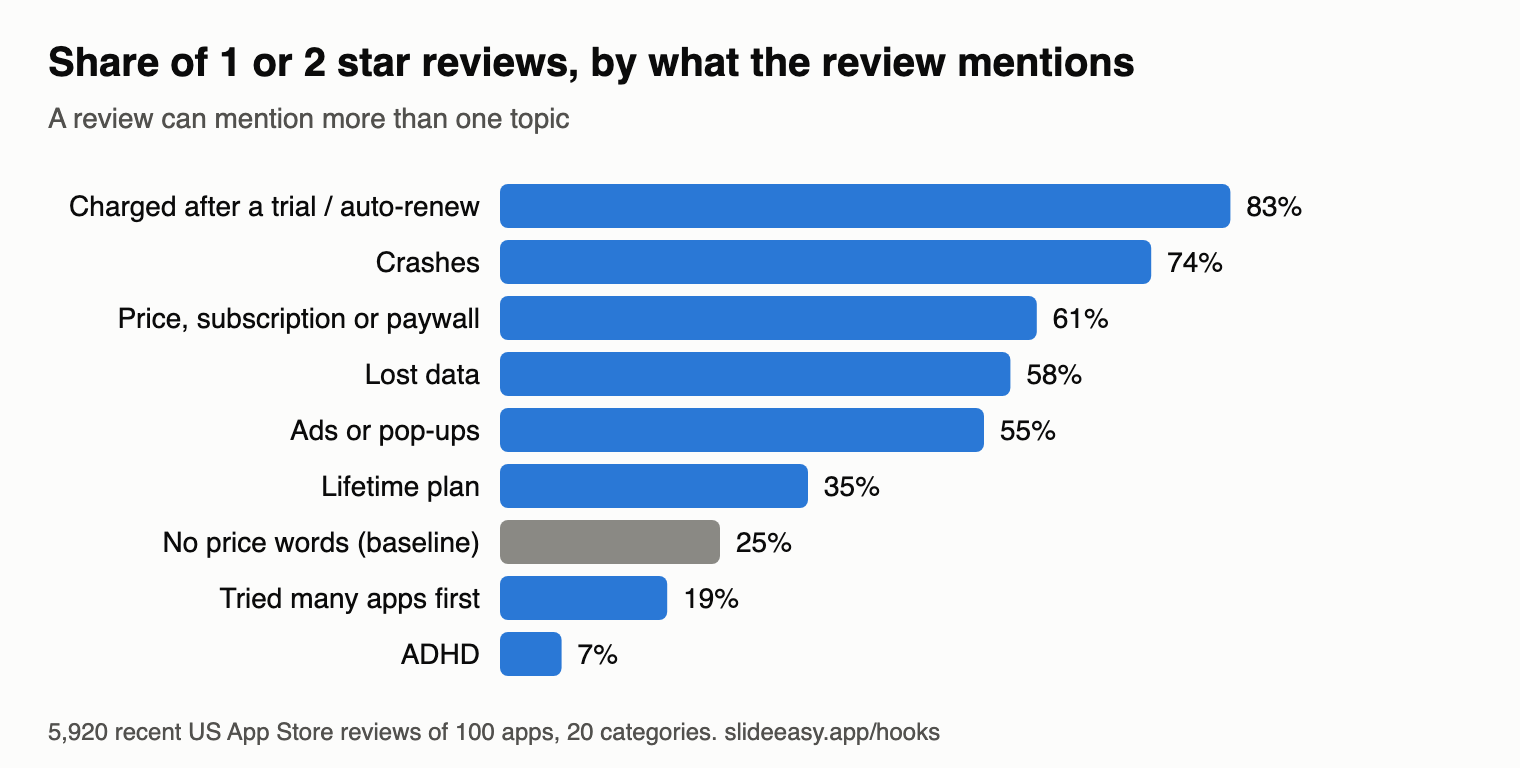
What surprised me is the other side of it. Reviews that mention a lifetime plan are mostly happy (58% happy, 35% low, from 62 reviews):
"I think $30 for lifetime access is very fair." (Habit Tracker - HabitKit)
"A lifetime membership was the best Christmas gift I could have given myself." (Balance: Meditation & Sleep)
People don't hate paying. They hate being surprised. For marketing, that means one clear line about what's free and what isn't does more for you than hiding it until the paywall.
Finding 2: happy reviewers write about their life, not your features
The happiest topic I counted wasn't a feature at all. 56 reviews mention ADHD, and 88% of them are 4 or 5 stars. Most come from to-do and focus-timer apps.
"cause my adhd brain thinks of things but not writing it down, i forget." (Finch: Self-Care Pet)
"As an ADHD brain, I really thrive on seeing the wins visually." (Habit Tracker - HabitKit)
The same pattern shows up in other words in other categories. In recipe apps, grocery lists and planning the week's meals come up far more than any recipe feature (on the recipes page, grocery lists appear in 91 reviews, 71 of them happy):
"This app cut down meal timing and grocery planning by over half!" (Mealime)
In meditation, it's sleep:
"it takes me hours to fall asleep normally and I keep waking up in the middle of the night." (Balance: Meditation & Sleep)
That last line is a better opening for a meditation Reel than anything I'd write. It's specific, it's a little uncomfortable, and the person who has that problem recognises themselves in it before they know what's being sold.
Finding 3: "I've tried so many apps" is a story people tell when they're happy
52 reviews say some version of "I tried a lot of these", and 71% of them are happy. It shows up in nearly every category.
"I've tried tons of habit trackers." (Habit Tracker - HabitKit)
"Tried every one on the App Store and this is by far the best." (To Do List MinimaList & Widget)
"i've tried a lot of travel planning apps, and this is the first one that's actually changed how i plan trips." (Rhyme - Itinerary Planner)
It's a small count, but it tells you who your best audience is: people already using a competitor, a bit tired of it. "If you've deleted three habit apps already" speaks to them directly. "The best habit app" speaks to nobody in particular.
Finding 4: crashes, lost data and ads undo everything else
Three topics sink ratings almost on their own:
| Topic | Reviews | Low (1–2 stars) |
|---|---|---|
| Crashes | 81 | 74% |
| Lost data | 26 | 58% |
| Ads or pop-ups | 184 | 55% |
The crash count is lumpy. Twelve of the 81 are one app, Microsoft To Do, after the iOS 27 update:
"Since the iOS 27 update, the app crashes on startup every time." (Microsoft To Do)
Lost data is rare, but it's the review people write in capital letters:
"I really enjoyed this app for a few years until it lost all my past trip history for 2025 and 2026." (TripIt)
And ads:
"Temu Style Aggressive Ads - Don't waste your time!" (Habit Tracker)
The marketing lesson is a dull one. If your newest reviews are about a crash, a Reel won't fix that, and paid or organic traffic will land on a product page that tells them not to install. Read your 1 and 2 star reviews as a bug list first.
Finding 5: how the app looks matters more than founders admit
For habit trackers, the most common theme in the habit tracker reviews isn't streaks or reminders. It's looks and customising: 54 reviews, 48 of them happy.
"I don't ever leave reviews but this app is so cute and fun and helpful." (Habit Tracker)
"I wish I could shake the hands of the designers and developers." (Habit Tracker)
Journaling apps show the same thing with stickers, fonts and themes. If your app is pretty, show the screen. A screen recording of someone colouring in their week does more than three bullet points about "customisable habits".
Categories are not the same
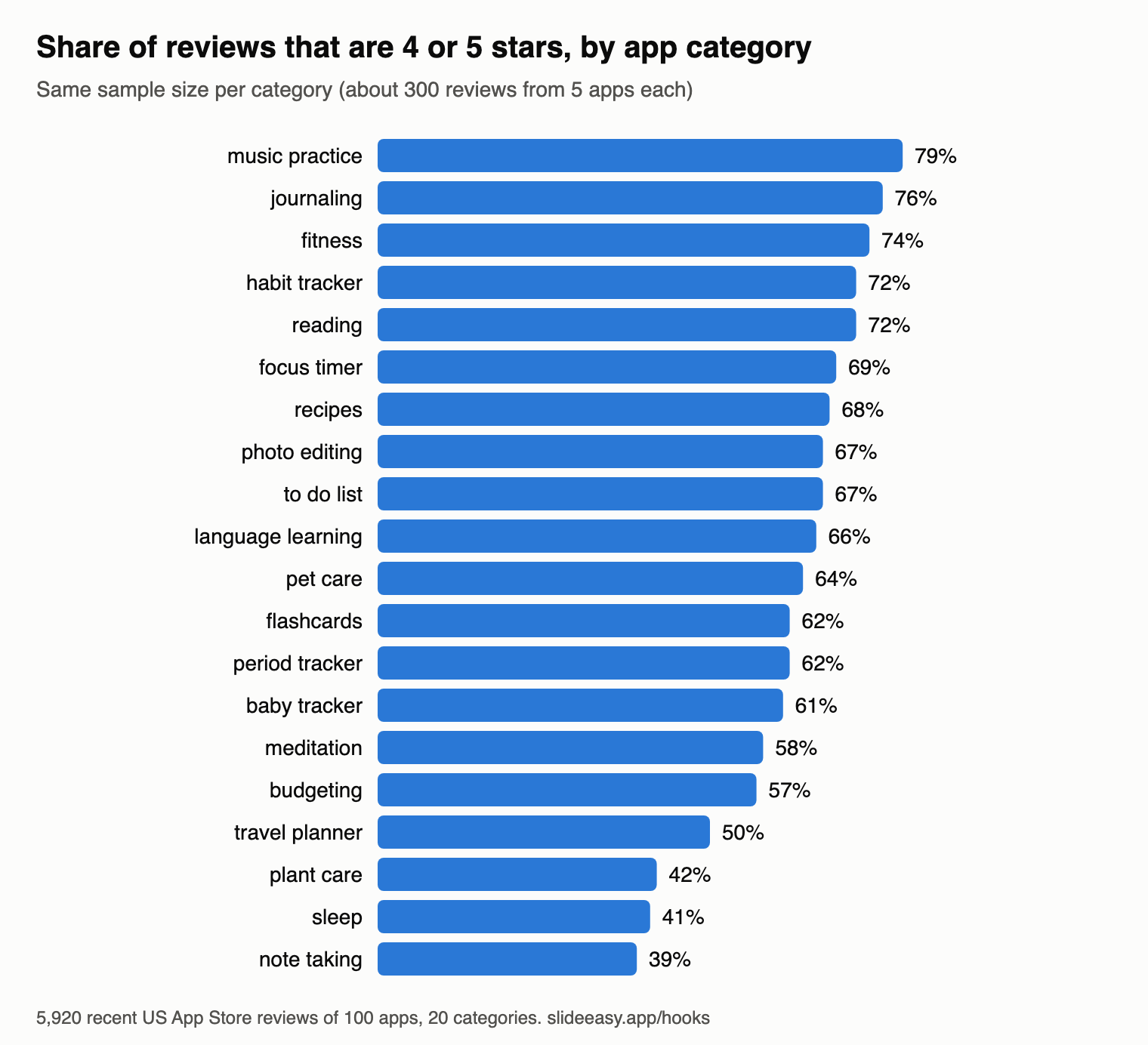
The happy share ranges from 79% (music practice: metronomes and tuners) down to 39% (note taking). Some of that is the category and some of it is the five apps I happened to pick, so treat the ranking as rough. Three categories side by side show how different the conversations are:
- Habit trackers (72% happy). People talk about looks, reminders and mental health. Price comes up in 18% of reviews, and fewer than half of those are happy.
- Budgeting (57% happy). The talk is about paychecks and the month, and about bank sync, which is mostly complaints (29 mentions, only 10 happy). One reviewer planned to switch after six years with another app because this one finally lets them "BUDGETS PAYCHECKS BIWEEKLY INSTEAD OF JUST MONTHLY" (Budget Bestie). That's a whole Reel.
- Meditation (58% happy). Teachers and voices are the most loved topic (47 mentions, 37 happy). Price is the most hated: 57 mentions, only 18 happy.
"Harris is an expert teacher and his neutral, calm and steady demeanor makes it easy to keep going each day." (Waking Up)
"Bank connection fail to sync at least a couple times a year." (Buddy: Budget Planner App)
So the content for each one is different. A habit app should show its screens. A budgeting app should talk about the 15th and the 30th of the month. A meditation app should put its voice front and centre and be upfront about the price.
Run this on your own app
You don't need my dataset for your own app. You need your reviews and a competitor's.
- Export the newest reviews for your app and one or two competitors. Apple's public data gives you the most recent few hundred per country; the free App Store review exporter turns the newest 200 for one country into a table and a CSV.
- Split by stars. The 4 and 5 star rows are your copy. The 1 and 2 star rows are your bug list, and your competitor's 1 and 2 star rows are your positioning.
- Search the text for life words, not feature words: "every morning", "my kids", "paycheck", "ADHD", "I tried", "finally", "used to". In a spreadsheet,
=REGEXMATCH(LOWER(E2), "tried|finally|used to")in a new column is enough. - Count, don't skim. Ten matching reviews out of 300 is a pattern. One vivid review is an anecdote, however good it reads.
- Copy the shape of the sentence, not the person. "It takes me hours to fall asleep" becomes the first line of a post about falling asleep. Don't paste someone's review into an ad and don't present it as a testimonial.
If you'd rather skip the spreadsheet, the Reel ideas by category pages have the counts, the common phrases and some example Reel hooks for all 20 categories, and the free hook generator runs the same idea on a single app's reviews in your browser. I built both, so I'm biased. For what to do with the words once you have them, see the guides, starting with 30 post ideas from real App Store reviews.
Limits
- Recency. Apple's public data only serves the newest reviews, so this is a snapshot of autumn 2026 for most apps. An app that just shipped a bad update (or a price change) is over-represented in its own category.
- US store only. All reviews are from the US storefront. They're mostly in English, but I didn't filter by language, and nothing here says anything about other countries.
- Five apps per category. The picks are whatever the App Store search returned first, so big brands dominate. A category's numbers can swing on one app.
- Regex, not reading. Matching "charged" catches "charged me twice" but also misses "took my money". The counts are lower bounds on how often a topic comes up, and some matches are false positives. I read through samples of each topic, not every match.
- Reviews are not users. People who write reviews are the very happy and the very annoyed. Most of your users never write one.
How this post was made
The numbers come from a short Python script over the same 5,920 reviews behind the category pages; every count and quote was checked against that data. The text was drafted with AI help from those numbers, then fact-checked against the data.